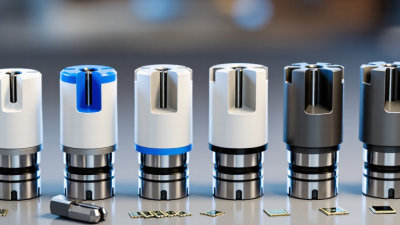
Top Die Pick Up Tools and Collets for Sale
Selecting Die Pick Up Tools and Collets is a small decision with visible consequences. A collet that fits the die can support stable pickup, clean placement, and fewer handling marks. The wrong face diameter or vacuum opening may cause tilt, slippage, or uneven contact. Tiny differences matter.
This guide introduces common tool and collet options for semiconductor die handling. It considers die size, thickness, surface finish, pickup speed, and equipment compatibility. It also explains why material choice and aperture geometry deserve close inspection. A polished ceramic face, for example, may suit one process, while another setup needs a different contact design. Always verify specifications against the machine and the die.
“Reliable pickup starts with matching the contact face to the die, then checking the process under real operating conditions,” says Jordan Lee, a composite die-attach process specialist created for this article. This is an illustrative quotation, not a sourced statement from a real individual. That distinction matters. Product claims and supplier specifications should be checked before purchase.
The pages ahead compare practical selection points for buyers, technicians, and production teams. They also cover maintenance, fit, and common causes of pickup instability. A useful tool is not simply the one with the lowest price. It is the one that performs consistently in your setup. Even careful selection cannot replace testing with actual dies. Small trials can expose weak assumptions before they become recurring production problems.

Die Pick-Up Tools in Semiconductor Assembly: Function and Applications
Top Die Pick Up Tools and Collets for Sale
In semiconductor assembly, a die pick-up tool lifts individual chips from dicing tape and transfers them for placement. A collet holds the die, often using controlled vacuum through a small opening. The tool’s shape and contact area must suit the die’s dimensions and surface. Small details matter. Poorly matched contact can cause chips, cracks, or placement shifts, especially with thin dies. Applications include die attach and flip-chip assembly, where consistent handling supports accurate bonding.
When selecting a tool, consider die thickness, size, tape release behavior, and the assembly machine’s alignment requirements. A soft or carefully finished contact surface can help protect fragile edges, while an appropriate vacuum level can reduce movement during transfer. Too much suction may damage a delicate die; too little may let it slip. There is no universal collet for every job. Trial runs with representative dies can reveal problems that specifications alone may miss. Inspect collets regularly for residue, wear, and blocked openings, since contamination can affect pickup consistency. Even a well-tuned setup needs monitoring; small process changes can alter release behavior. That part is easy to underestimate.
Tool and Collet Types: Ceramic, Carbide, and Polymer Contact Tips
The pick-up performance depends on the contact tip as much as the tool body. Ceramic tips resist heat and wear, and their electrical insulation can suit sensitive handling setups. They are hard, though, and a chipped edge may mark a die. Check the tip under magnification and keep its face clean. Small details matter.
Carbide tips offer strong wear resistance and hold their shape through repeated cycles. Their stiffness can support consistent placement, but a rough or misaligned contact face may scratch delicate surfaces. A collet must also grip evenly; uneven pressure can shift a die or stress its edges. Match the opening and contact geometry to the die dimensions, then verify pickup stability at the intended vacuum or holding force.
Polymer contact tips are more compliant and can reduce surface marking on fragile parts. They may wear, deform, or collect residue faster than ceramic or carbide, especially under heat or repeated contact. Not always. Inspect them often and replace them when the face becomes uneven. Material choice is rarely a simple ranking. A practical evaluation uses representative dies, checks for residue and edge damage, and records placement consistency over repeated cycles. One overlooked issue is that a tip that works well on one die finish may not suit another.
Key Specifications: Tip Geometry, Concentricity, and Runout per ISO 1101
When comparing die pick up tools and collets for sale, examine tip geometry against the die size and pickup method. A flat tip spreads contact across a small surface; a conical tip centers on a defined feature. Check the tip diameter, edge condition, and clearance around nearby components. Under magnification, even a tiny burr can shift contact or mark a delicate surface. Small details matter.
Concentricity describes how closely the tip’s axis aligns with the tool or collet axis. Runout measures the tip’s variation as the assembly rotates. They are related, but not interchangeable. ISO 1101 provides a framework for geometric tolerancing; the applicable tolerance and datum reference should come from the engineering drawing. Do not assume an ISO reference alone sets an acceptable runout value. The setup matters.
For a practical check, mount the tool in its intended collet, clean the contact surfaces, and measure near the working tip with a suitable indicator. Rotate the spindle slowly and record the total indicated movement. Repeat after reseating the tool; inconsistent readings may point to contamination, clamping variation, or measurement technique. That part is easy to overlook. A specification is useful only when the test method and reference conditions are clear, and tolerances should suit the actual pickup task rather than look impressive on paper.
Vacuum Grip Sizing: Holding Force F = ΔP × A
Top Die Pick Up Tools and Collets for Sale
Vacuum grip sizing starts with F = ΔP × A. Here, ΔP is the pressure difference across the die, and A is the sealed contact area. More area or greater pressure difference increases ideal holding force. A 2 mm² pickup area at 40 kPa produces 0.08 N, or roughly 8.2 grams-force, before losses. That is modest. NIST lists standard atmospheric pressure as 101.325 kPa, the approximate upper limit for vacuum differential at sea level—not a practical operating target (NIST, SI reference data).
Real pickup is less tidy. Surface texture, dust, leakage, and die curvature can shrink the effective sealed area. Acceleration matters too: a die may hold during lifting, then slip during a fast lateral move. Allow margin. Measure vacuum near the pickup tip under working conditions, rather than relying only on a pump’s rated pressure. ISO 21360-1:2020 specifies methods for measuring vacuum-pump performance; tool-side readings help reveal losses between pump and collet. This equation is useful, but incomplete. Test with representative dies, including the smallest and most fragile parts. A slightly uneven seal can change the result more than the calculation suggests.
Selection Checks: Die Dimensions, Bonder Interface, and Collet Fit
Choosing die pick-up tools starts with the die drawing, not the catalog photo. Confirm length, width, thickness, corner shape, and any keep-out zones. Then check the bonder interface: mounting thread, holder geometry, tool length, and available Z travel. Even a small height mismatch can change pickup pressure or placement. Small details matter.
Collet fit depends on the die’s contact area and surface. Match the cavity or opening to the die outline, and check that vacuum ports do not sit over fragile features. For thin or warped dies, inspect the part under magnification and test pickup on representative samples. A tight fit is not automatically a good fit. I would not trust nominal dimensions alone; actual die variation can make a drawing look more certain than the process is.
SEMI’s 2024 year-end equipment market report recorded worldwide semiconductor manufacturing equipment sales of $117.1 billion, up 10% from 2023. That figure does not prescribe a collet size, but it reflects continued investment in precision manufacturing. For procurement, record the die dimensions, interface details, and collet contact pattern together. Test the actual die. Keep the first trial notes, including failures; they often reveal a clearance or vacuum issue that a specification sheet misses.