Leave Your Message
Choosing the best TPT Wire Bonder for global sourcing requires more than comparing prices. The right machine must match your package design, wire material, production volume, and service expectations. A bonder that handles fine gold wire may not deliver stable results with copper wire. Small differences matter. Bond force, ultrasonic power, loop control, clamp design, and vision accuracy can affect every unit leaving your line.
Professor John H. Lau, a widely recognized authority in semiconductor packaging, offers a practical reminder: “Wire bonding quality depends on process control, equipment capability, and operator skill.” This principle should guide every TPT Wire Bonder evaluation. Ask suppliers for sample bonds, pull-test data, shear-test results, and repeatability records. Inspect the machine’s footprint, software interface, spare-parts availability, and training coverage. Global sourcing also requires careful attention to electrical standards, shipping protection, installation support, and documentation.
Cost still matters. It should not dominate the decision. A cheaper machine may create hidden expenses through downtime, difficult calibration, or delayed technical support. That risk is easy to underestimate. Buyers should compare total ownership costs across several years, not only the purchase quotation. Factory visits, reference checks, and production trials can reveal practical weaknesses that brochures rarely show. No selection process is perfect, and even experienced teams may overlook maintenance habits or operator learning curves. A careful, evidence-based review makes the TPT Wire Bonder choice more reliable.
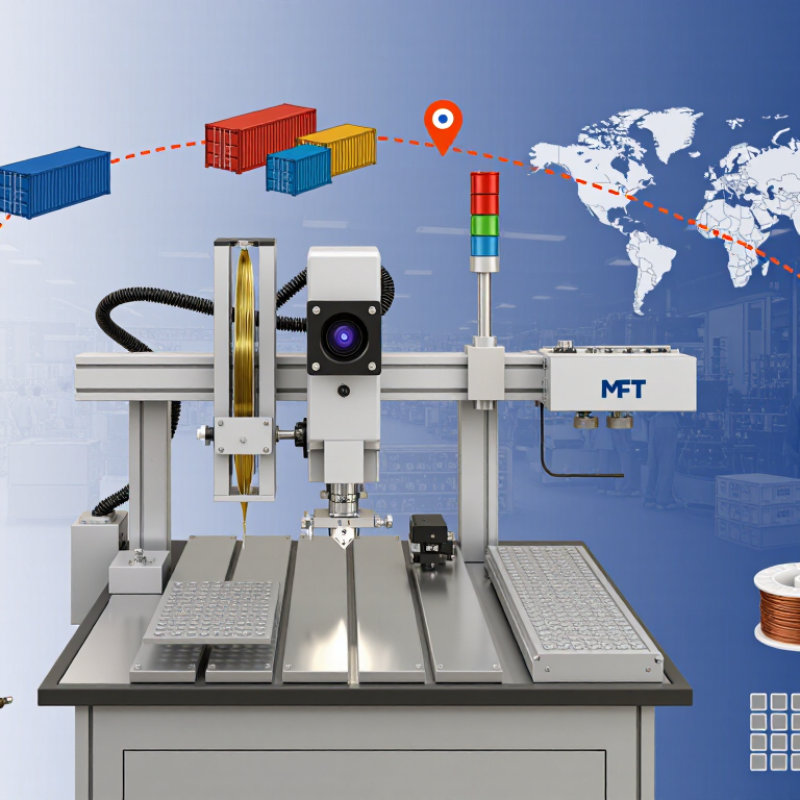
How to Choose the Best TPT Wire Bonder for Global Sourcing?
Define TPT wire bonder types and core applications before comparing suppliers. A fine-wire ball bonder uses thermosonic bonding for integrated circuits and compact sensor packages. A wedge bonder supports aluminum or copper wire, often in power modules, LED assemblies, and battery protection systems. Heavy-wire models handle larger current paths. Ribbon bonders suit wide, low-resistance connections. Each type needs different clamps, tooling, ultrasonic power, and operator skills. The wrong platform can create hidden maintenance costs.
Industry demand supports careful capacity planning. SEMI’s World Fab Forecast 2024 tracks more than 1,400 semiconductor facilities and production lines worldwide. WSTS reported a global semiconductor market forecast of about 697 billion US dollars for 2025. These figures suggest broader packaging demand, but they do not guarantee your target segment will grow. I have seen sourcing teams choose speed first, then struggle with bond pull strength and spare-part availability. That choice needs reflection. Request sample bonds, capability studies, and process data under your actual wire diameter. Check temperature stability, vision accuracy, cycle time, and software traceability. Also verify local service coverage and training response times.
Tips: Match the bonder to the application, not the brochure. Define wire material, diameter, bond pitch, package size, and expected monthly output. Ask for data from at least three production lots. Confirm standards, calibration records, warranty terms, and replacement lead times before signing. Small details matter.
| Wire Bonder Type | Primary Bonding Method | Typical Wire and Material Range | Core Applications | Main Advantages | Key Limitations | Global Sourcing Checkpoints |
|---|---|---|---|---|---|---|
| Automatic Ball Bonder | Thermosonic bonding using ultrasonic energy, bonding force, and controlled heat. Forms a free-air ball at the wire tip before the first bond. |
Gold wire
Copper wire
Palladium-coated copper Common fine-wire diameters are approximately 15–50 µm, depending on the device and process. |
Integrated circuits, memory devices, sensors, LEDs, power-management packages, and other fine-pitch semiconductor packages. | High automation potential, fast cycle times, repeatable ball formation, and strong compatibility with fine-pitch wire interconnection. | Requires stable temperature control, accurate capillary alignment, suitable bonding surfaces, and tightly controlled wire-feed conditions. | Verify supported wire materials, capillary availability, bond-loop control, automatic vision functions, recipe transfer, and spare-parts lead time. |
| Automatic Wedge Bonder | Ultrasonic wedge bonding. The wire is bonded through a wedge tool without forming a free-air ball. |
Aluminum wire
Gold wire
Copper wire Frequently used from approximately 18–500 µm, with larger sizes available for power applications. |
Power semiconductors, discrete devices, hybrid circuits, automotive modules, LED packages, battery connections, and thick-wire interconnects. | Suitable for thick wire, low-loop profiles, temperature-sensitive substrates, and applications requiring robust current-carrying connections. | May have lower throughput than high-speed ball bonding in some fine-wire applications; tool orientation and wire direction can affect layout flexibility. | Confirm maximum wire diameter, wedge-tool geometry, bonding angle, ultrasonic power range, substrate compatibility, and support for long or short wire loops. |
| Manual or Semi-Automatic Wedge Bonder | Operator-assisted ultrasonic wedge bonding with manual or partially automated positioning. |
Aluminum
Gold
Copper Often selected for fine-wire laboratory work, engineering builds, and thicker wires used in power modules. |
Prototyping, failure analysis, engineering samples, low-volume production, repair work, and process development. | Lower initial investment, flexible changeover, practical for non-standard layouts, and useful when production volume is limited. | Throughput and consistency depend more heavily on operator skill; process data collection and automated inspection may be limited. | Evaluate ergonomic design, operator training requirements, microscope and vision options, parameter repeatability, documentation, and local service availability. |
| Heavy-Wire Wedge Bonder | High-power ultrasonic wedge bonding, normally with controlled force and optional heated workholding. |
Aluminum wire
Copper wire Commonly used for approximately 100–500 µm wire, depending on the package, tool, and bonding process. |
IGBT and MOSFET modules, rectifiers, traction inverters, industrial power electronics, renewable-energy converters, and high-current assemblies. | Supports high-current paths, large bond footprints, low electrical resistance, and mechanically robust interconnects. | Needs rigid fixturing, high ultrasonic capability, adequate work-space clearance, and careful control of substrate stress and bond deformation. | Check bond-force capacity, ultrasonic power, tool life, wire-payoff design, substrate clamping, cooling requirements, and qualification support for power cycling. |
| Thermosonic Fine-Wire Bonder | Combination of ultrasonic energy, heat, and mechanical force for fine-wire ball or wedge bonding. |
Gold
Copper
Coated copper Typically used with fine wires in the approximate 15–50 µm range. |
Fine-pitch ICs, image sensors, RF and mixed-signal packages, miniaturized medical electronics, and compact consumer devices. | Enables small bond dimensions, precise loop control, and compatibility with advanced miniaturized packaging designs. | Sensitive to contamination, pad metallurgy, oxide formation, humidity, and temperature uniformity; copper processes may require additional process controls. | Request bond-pull and shear data, wire-specific process windows, gas or atmosphere requirements, vision accuracy, and validated recipes for the target package. |
| Ribbon Bonder | Ultrasonic or thermosonic bonding using flat metal ribbon rather than round wire. |
Aluminum ribbon
Copper ribbon Ribbon width and thickness vary by package design and current requirement. |
Power modules, high-current battery systems, automotive electronics, LED assemblies, and applications requiring broad low-resistance connections. | Provides a larger contact area than round wire, supports high-current conduction, and can reduce the number of parallel interconnects. | Requires ribbon-specific clamps, tools, feeders, and process recipes; layout and tool access must be considered during package design. | Confirm ribbon dimensions, tool compatibility, feeder stability, bond-footprint control, replacement-tool cost, and compatibility with the customer’s metallization. |
| Flip-Chip or Bump-Oriented Interconnect Equipment | Usually uses thermo-compression, thermosonic, or ultrasonic techniques to join bumps or micro-interconnects rather than conventional wire loops. |
Solder bumps
Gold stud bumps
Copper pillars Selection depends on bump pitch, bump metallurgy, substrate type, and assembly temperature limits. |
High-density logic, image sensors, RF modules, MEMS, display drivers, and advanced semiconductor packages. | Supports very short interconnect paths, high input/output density, and compact package architectures. | It is not a direct substitute for conventional wire bonding; alignment, bump coplanarity, wafer handling, and thermal control are critical. | Confirm whether the equipment is truly required for the package, then evaluate placement accuracy, force uniformity, thermal profile, substrate handling, and inspection integration. |